
SEO vs AEO vs GEO is becoming an important topic as the way people search continues to change.
A few years ago, most people searched on Google, opened a few websites, compared the information, and made a decision.
Today, that process looks different.
People still use Google, but they also ask questions through AI tools, voice assistants, AI search features, and other answer-based platforms.
This is where three terms have become important for businesses:
- SEO
- AEO
- GEO
You may already have heard of SEO. But what exactly are AEO and GEO? Do you need all three? Or should your business focus on one?
Let’s break it down in simple terms.
What Is SEO?
SEO stands for Search Engine Optimization.
It is the process of improving your website and content so search engines can understand your pages and show them for relevant searches.
For example, imagine you run a digital marketing institute in Nagpur.
You may want your website to appear when someone searches for:
- Digital Marketing Course in Nagpur
- SEO course in Nagpur
- Best digital marketing institute in Nagpur
- Digital marketing classes near me
- Digital marketing course with placement
SEO helps you build visibility for these searches.
It covers several areas, including:
- Keyword research
- On-page SEO
- Technical SEO
- Internal linking
- Content creation
- Website structure
- Page speed
- Mobile usability
- Local SEO
- Backlinks
- Search intent
The basic idea is simple.
You create useful content, make your website easy for search engines to understand, and build enough trust and relevance to compete in search results.
What Is AEO?
AEO stands for Answer Engine Optimization.
The focus is slightly different from traditional SEO.
Instead of only trying to rank a webpage, AEO focuses on making your content useful for direct answers.
Think about the way people ask questions today.
For example:
“What is SEO?”
“How does local SEO work?”
“What should I learn before joining a digital marketing course?”
“What are the benefits of learning SEO?”
People want answers quickly.
AEO helps structure your content so answer-focused systems can understand and extract useful information from it.
This means your content should answer questions clearly.
For example, instead of writing a long paragraph explaining SEO, you could start with:
“SEO is the process of improving a website so it can appear more prominently for relevant searches.”
Then explain the topic in more detail.
This simple structure helps readers and machines understand the information.
What Is GEO?
GEO usually refers to Generative Engine Optimization.
It focuses on improving the chances of your content being understood, referenced, or surfaced by generative AI and AI-powered search experiences.
This is different from traditional search results.
A person may ask an AI tool:
“Which skills should I learn to start a career in digital marketing?”
The system may generate an answer instead of simply displaying ten blue links.
Your business needs content that provides clear, useful, trustworthy information if you want to be considered a relevant source.
GEO focuses on things such as:
- Clear explanations
- First-hand experience
- Reliable information
- Author credibility
- Specific examples
- Strong topical coverage
- Helpful data
- Clear sources
- Well-structured content
So, SEO helps you compete in search results.
AEO helps your content answer questions.
GEO focuses on visibility in generative search experiences.
SEO vs AEO vs GEO: What Is the Difference?
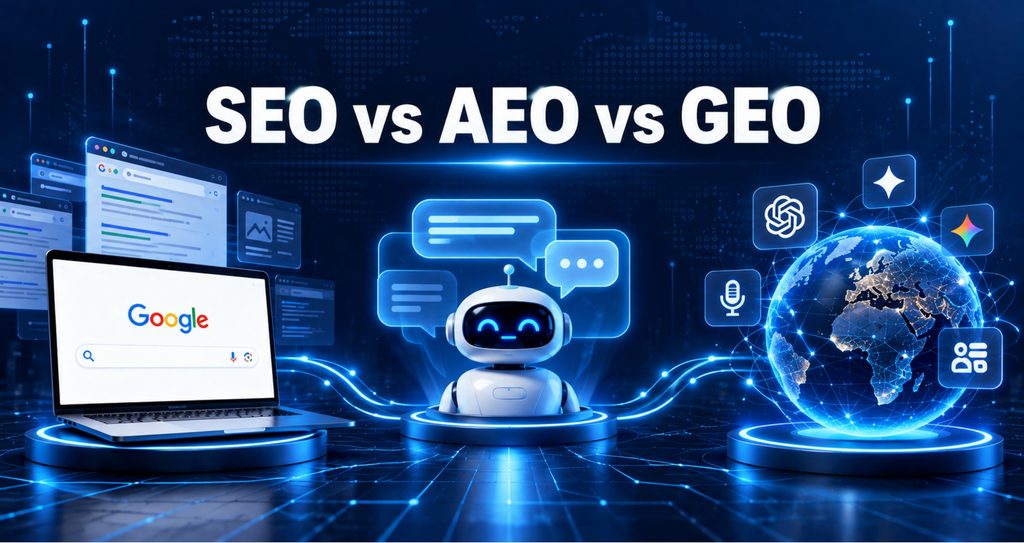
The three strategies overlap, but they have different primary goals.
| Strategy | Main Focus | Typical User Behaviour |
| SEO | Search visibility | User searches and visits websites |
| AEO | Direct answers | User asks a specific question |
| GEO | AI-generated answers | User asks an AI or generative search system |
For example, someone searching for “Digital Marketing Course in Nagpur” may be looking for course pages, institutes, fees, syllabus, reviews, and other information.
That is mainly an SEO opportunity.
Someone asking “What does a digital marketing course teach?” creates an AEO opportunity.
Someone asking an AI system “What should I look for when choosing a digital marketing course in Nagpur?” creates a GEO opportunity.
The same business can create content for all three.
Do You Need SEO, AEO and GEO?
For many businesses, the answer is not about choosing one and ignoring the others.
Your content can support all three.
Think about a blog article on digital marketing courses.
For SEO, you may target keywords such as:
“Digital Marketing Course in Nagpur“
For AEO, you can answer questions such as:
“What is included in a digital marketing course?”
For GEO, you can provide detailed information that helps AI systems understand your expertise, services, location, course structure, and experience.
One piece of content can serve multiple purposes.
The trick is not to write separate content just because there are three acronyms.
Write genuinely useful content first.
Then structure it properly.
How SEO Helps Your Business
SEO remains important because people still use search engines to discover businesses, services, products, and information.
A strong SEO strategy can help your business appear for searches related to your services.
For a local education business, this could include:
- Digital Marketing Course in Nagpur
- SEO Training in Nagpur
- Social Media Marketing Course in Nagpur
- PPC Course in Nagpur
- Digital Marketing Classes in Nagpur
For a healthcare business, the searches could be completely different.
For example:
- Dentist in Nagpur
- Physiotherapist near me
- Skin specialist in Nagpur
- PCOS nutritionist in Nagpur
The keyword should match what your audience actually searches for.
That is why keyword research and search intent still matter.
How AEO Helps Your Business
AEO makes your content easier to use as an answer.
One simple way to start is by identifying questions your customers ask regularly.
You can find these questions through:
- Google search suggestions
- People Also Ask
- Customer conversations
- Reddit discussions
- Quora questions
- Search Console data
- Sales and support questions
- Keyword research tools
Then create direct answers.
For example:
What Is a Digital Marketing Course?
A digital marketing course teaches practical skills used to promote businesses and websites through online channels such as search engines, social media, email, paid advertising, and content marketing.
You can then expand the answer with examples, course modules, career options, and practical applications.
This gives readers a quick answer while still providing depth.
How GEO Helps Your Business
GEO requires you to think beyond keywords.
AI systems need context.
Suppose your website says:
“We provide digital marketing training.”
That tells very little.
A stronger page might explain:
- Who teaches the course
- Where the institute is located
- What modules are covered
- How practical training works
- Who the course is suitable for
- Course duration
- Projects students work on
- Certifications offered
- Faculty experience
- Student outcomes
- Frequently asked questions
Now there is more information for both people and machines to understand.
This is one reason detailed, well-organised content matters.
E-E-A-T and SEO, AEO and GEO
You will often hear about E-E-A-T when discussing modern SEO.
E-E-A-T stands for:
- Experience
- Expertise
- Authoritativeness
- Trustworthiness
One important clarification is needed here.
E-E-A-T is not a separate Google algorithm.
It is a set of concepts Google uses in its search quality guidance to describe qualities associated with helpful and trustworthy content.
For businesses creating content, these concepts are still useful.
Experience
Show real experience where appropriate.
For example, a digital marketing institute could discuss actual classroom projects, practical assignments, campaign exercises, or common mistakes students make.
Expertise
Content should demonstrate knowledge of the subject.
An article about technical SEO should not simply repeat basic definitions. It should explain practical issues and give useful examples.
Authoritativeness
Make it clear who is behind the information.
Add relevant author information, professional experience, qualifications, and links to useful supporting resources when appropriate.
Trustworthiness
Be clear about your business, services, claims, contact information, policies, and sources.
Don’t make claims that you cannot support.
For YMYL topics such as healthcare and finance, this becomes even more important.
How to Create Content for SEO, AEO and GEO Together
You don’t need three completely different content strategies.
Start with one strong topic.
For example:
“How to Choose a Digital Marketing Course in Nagpur”
Then build the article around different search needs.
Step 1: Choose a clear primary topic
Select one main keyword or search topic.
For example:
“Digital Marketing Course in Nagpur”
Don’t force the keyword into every paragraph.
Use it naturally.
Step 2: Understand search intent
Ask yourself:
“What does the person actually want?”
Someone searching for a course may want information about:
- Fees
- Duration
- Syllabus
- Certifications
- Trainers
- Placement support
- Practical projects
- Career opportunities
- Location
Cover the information that helps them make an informed decision.
Step 3: Add direct answers
Create question-based sections.
Examples:
“What is taught in a digital marketing course?”
“How long does a digital marketing course take?”
“Is digital marketing suitable for beginners?”
“Which digital marketing skills are in demand?”
Keep the first answer short, then explain further.
This supports AEO.
Step 4: Add real experience
Don’t make the article sound like it was copied from ten other websites.
Add genuine examples.
If students commonly struggle with keyword research, explain why.
If beginners often confuse SEO and PPC, explain the difference.
This gives your content a human layer.
Step 5: Build topical depth
Don’t publish one article and stop.
Create supporting content around the main subject.
For a digital marketing institute, this could include:
- What Is SEO?
- How Does Google Search Work?
- SEO vs PPC
- What Is Technical SEO?
- What Is Keyword Research?
- How Does Local SEO Work?
- What Is Content Marketing?
- What Is AEO?
- What Is GEO?
- How to Build a Digital Marketing Career
- Digital Marketing Skills Beginners Should Learn
Connect these articles with relevant internal links.
This helps users discover related information and gives search engines more context about your website.
Common SEO, AEO and GEO Mistakes
Many businesses make the same mistakes.
Stuffing keywords everywhere
Writing “Digital Marketing Course in Nagpur” ten times in a short article will not automatically improve the page.
Write naturally.
Use related phrases where they make sense.
Writing only for search engines
If your article feels unnatural to a human reader, something has gone wrong.
Your reader comes first.
Ignoring questions
People search in question formats all the time.
If your content never answers basic questions, you may miss useful search opportunities.
Making vague claims
Statements such as “We are the best institute” don’t provide much useful information.
Explain what makes your course different.
Give specific information.
Publishing without experience
Generic content is easy to find.
Your own observations, examples, processes, and practical knowledge can make an article more useful.
Forgetting local intent
If your business serves Nagpur, mention relevant local information naturally.
A page targeting “Digital Marketing Course in Nagpur” should clearly explain its Nagpur location and the audience it serves.
Don’t add the city name repeatedly just for the keyword.
Which Strategy Should Your Business Focus On?
The answer depends on your business and audience.
If your website receives most visitors through traditional search, SEO should remain a major part of your strategy.
If customers frequently ask questions, add AEO-focused content.
If your audience increasingly discovers information through AI-generated search experiences, build content that provides clear context, evidence, expertise, and useful answers.
For many businesses, these strategies work together.
You don’t have to choose between SEO, AEO and GEO.
Instead, build content that is:
- Easy to find
- Easy to understand
- Easy to extract answers from
- Supported by experience and expertise
- Useful enough that people want to read it
That approach makes more sense than chasing every new search term or platform.
SEO vs AEO vs GEO: A Simple Strategy for Beginners
If you’re new to digital marketing, don’t try to learn everything at once.
Start with SEO fundamentals.
Learn:
- Keyword research
- Search intent
- On-page SEO
- Technical SEO
- Internal linking
- Content writing
- Local SEO
- Google Search Console
- Analytics
- Competitor research
Then learn how AEO changes content structure.
After that, explore GEO and how generative search experiences use information.
This is also useful if you are considering a Digital Marketing Course in Nagpur.
Look for training that teaches the basics first and then introduces newer search approaches through practical examples.
Frequently Asked Questions
What is the difference between SEO, AEO and GEO?
SEO focuses on improving visibility in search engines. AEO focuses on providing direct answers to user questions. GEO focuses on improving how content can be understood and surfaced in generative AI search experiences.
Is SEO still important with AI search?
Yes. AI search does not make the fundamentals of having useful, accessible, trustworthy content irrelevant. Search behaviour is changing, but businesses still need discoverable and useful information.
Is AEO a replacement for SEO?
No. AEO is better understood as an additional approach to content creation. Many AEO practices can work alongside traditional SEO.
Is GEO the same as SEO?
No. There is some overlap, but the focus differs. SEO generally targets search engine visibility, while GEO focuses on content visibility and understanding within generative search experiences.
How can I optimize content for AEO?
Start by answering real questions directly. Use clear headings, concise answers, structured sections, examples, FAQs, and supporting details.
How can businesses improve GEO?
Create useful, trustworthy content with clear authorship, first-hand experience, relevant evidence, specific information, and strong topical coverage. Make your website easy to understand and keep important business information clear.
Final Thoughts
SEO, AEO and GEO are not three completely separate worlds.
They overlap.
SEO helps people discover your website.
AEO helps your content provide clear answers.
GEO helps you prepare content for generative search experiences.
The strongest starting point is still simple: understand your audience, answer their questions, provide useful information, and show why your business has real knowledge of the subject.
Search will continue to change.
Your content should be useful enough to change with it.