
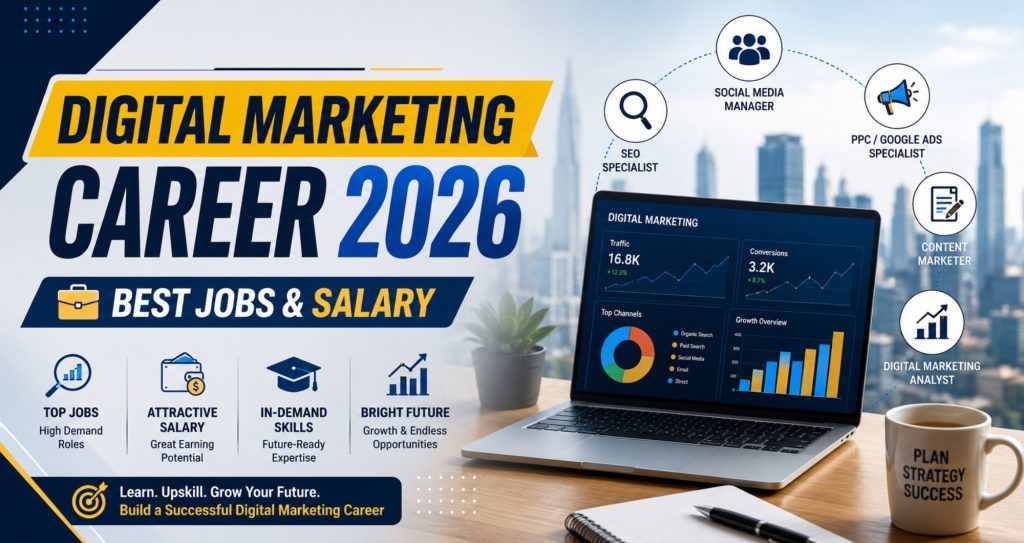
If you are thinking about starting a career in digital marketing in 2026, you are probably asking a few simple questions. Is there really a future in it? What jobs can you get? How much can you earn? And most importantly, what should you learn first?
The short answer is yes, digital marketing can be a good career choice, but learning only the basics is no longer enough. Employers increasingly look for people who can work with SEO, paid advertising, analytics, content, social media, and AI tools. India’s digital advertising market is also continuing to grow, with projections putting it at around US$22 billion by 2030.
If you are based in Nagpur or another growing city, you don’t necessarily need to move to Mumbai or Bengaluru to start learning these skills. You can build your knowledge locally, create a practical portfolio, and then apply for agency, in-house, remote, or freelance opportunities.
Quick Answer
A digital marketing career involves promoting businesses, products, and services through online channels such as search engines, social media, websites, email, and paid advertising.
In 2026, common career paths include SEO, Google Ads, social media marketing, content marketing, email marketing, analytics, and performance marketing. Your salary depends on your skills, experience, location, role, and ability to show real results.
What Is a Digital Marketing Career?
Digital marketing is much broader than posting on Instagram.
A digital marketer may work on:
- Search engine optimization (SEO)
- Google Ads and PPC campaigns
- Social media marketing
- Content marketing
- Email marketing
- Website marketing
- Lead generation
- Google Analytics and reporting
- Conversion rate improvement
- Performance marketing
Think about a local business that wants more customers.
Someone needs to help that business appear when people search on Google. Someone needs to create useful content. Someone may run paid ads. Another person may check which campaigns are bringing enquiries.
These are all parts of digital marketing.
Why Choose a Digital Marketing Career in 2026?
Digital marketing is closely connected to how people discover and compare businesses today.
India’s digital advertising market is expected to nearly double to US$22 billion by 2030, driven by internet usage, smartphones, social media, video, e-commerce, and other digital channels.
This creates opportunities across industries.
You can find digital marketing work in:
- E-commerce
- Education
- Healthcare
- Real estate
- IT and software
- Hospitality
- Finance
- Retail
- Startups
- Digital marketing agencies
The work is also not limited to one type of company. That makes the field useful if you are still figuring out which industry interests you.
What Are the Main Digital Marketing Career Options?
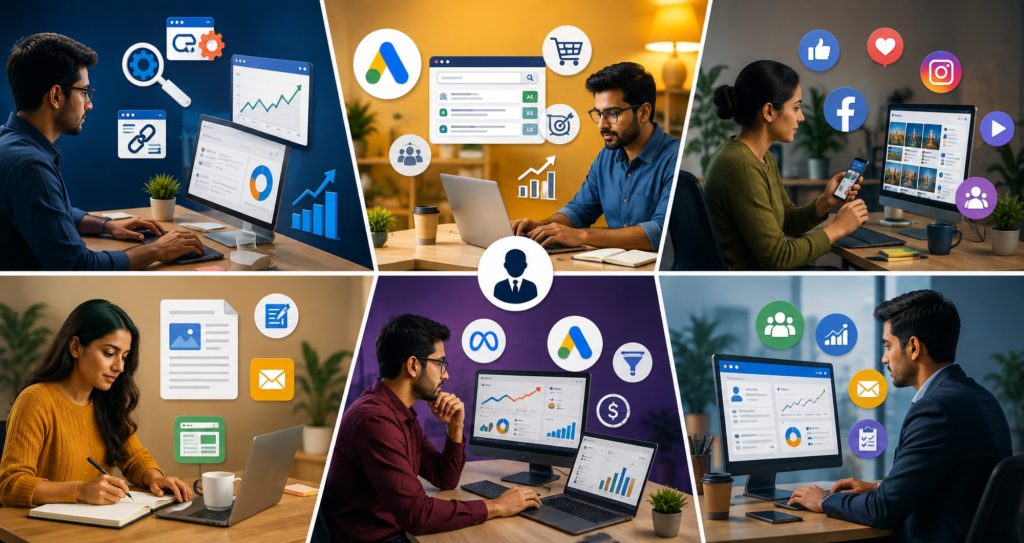
You don’t have to become a general digital marketer forever.
As you gain experience, you can specialise.
1. SEO Specialist
An SEO specialist helps websites improve their visibility in search engines.
Your work may include keyword research, on-page SEO, technical SEO, content planning, internal linking, and performance analysis.
2. Google Ads or PPC Specialist
PPC professionals create and manage paid search campaigns.
You may work with:
- Search campaigns
- Display campaigns
- Shopping campaigns
- Remarketing
- Conversion tracking
This role suits people who enjoy numbers, testing, and campaign analysis.
3. Social Media Manager
Social media professionals plan content, manage platforms, study audience behavior, and track engagement.
It is more than simply creating posts.
You need to understand why a particular post worked and another one didn’t.
4. Content Marketer
Content marketers create blogs, landing pages, guides, emails, and other useful material that helps attract or educate potential customers.
Good writing helps, but understanding the audience is just as important.
5. Performance Marketer
Performance marketing focuses strongly on measurable results such as leads, sales, conversions, and acquisition costs.
It often involves platforms such as Google Ads and Meta Ads along with analytics and conversion tracking.
6. Digital Marketing Executive
This can be a useful starting role for freshers.
You may get exposure to several areas instead of specialising immediately.
That experience can help you decide whether you prefer SEO, paid ads, content, social media, or analytics.
What Skills Do You Need for a Digital Marketing Career?
You don’t need to learn everything in one week.
Start with the fundamentals and gradually build practical skills.
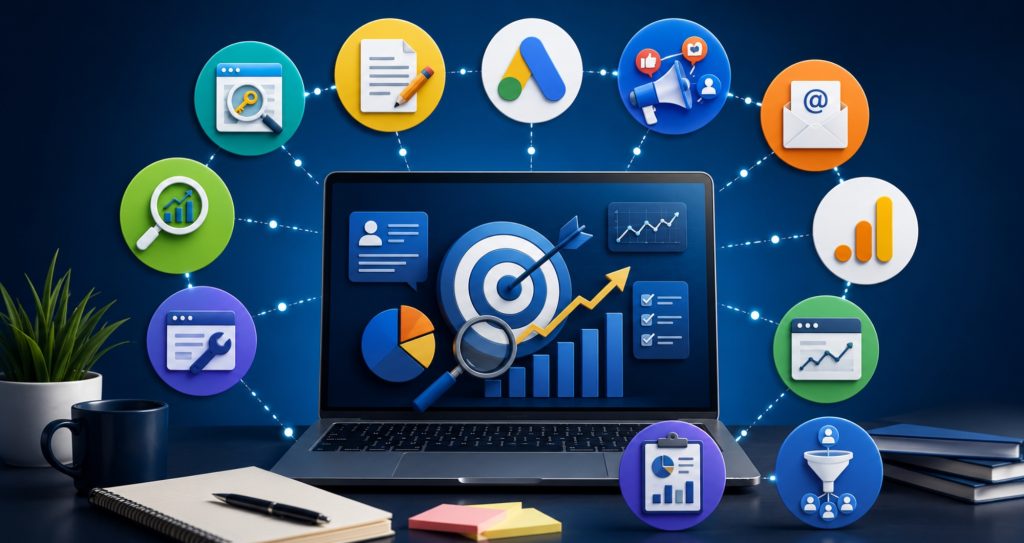
Core skills
- SEO
- Keyword research
- Content writing
- Google Ads
- Social media marketing
- Email marketing
- Google Analytics
- Search Console
- Basic conversion tracking
- Reporting and data analysis
Skills that are becoming more useful
AI is also changing how marketers work.
AI tools can help with research, content ideas, data analysis, and repetitive tasks. But that doesn’t mean you can simply copy AI-generated content and call yourself a marketer.
You still need to understand:
- Search intent
- Audience behaviour
- Brand messaging
- Data
- Campaign strategy
- Fact-checking
- Content quality
The better approach is to use AI as a tool while keeping human judgment in the process.
How Much Does a Digital Marketer Earn in India?
There isn’t one fixed digital marketing salary.
A fresher may start at a relatively modest salary, while someone with several years of experience and strong skills can earn considerably more.
Your earning potential can depend on:
| Factor | Why it matters |
| Experience | More experience can lead to senior roles. |
| Specialisation | Some skills command a stronger demand. |
| Location | Salaries differ between cities. |
| Portfolio | Real work can strengthen your profile. |
| Company | Agencies and brands have different pay structures. |
| Results | Measurable campaign results can help career growth. |
Be careful with websites or courses promising a fixed salary after training. No course can honestly guarantee a particular package.
A better question is: What skills do employers want, and can I prove that I have them?
How Can Freshers Start a Digital Marketing Career?
This is where many beginners make a mistake.
They collect five or six certificates but have nothing practical to show during an interview.
Instead, try this approach.
Step 1: Learn the fundamentals
Understand how SEO, paid advertising, social media, content, and analytics work.
Step 2: Pick a few core skills
You don’t need to master every platform immediately.
For example, start with:
SEO + Content + Analytics
or
Google Ads + Analytics + Landing Pages
Step 3: Work on practical projects
Create a small website or work on a sample business project.
Try activities such as:
- Keyword research
- Competitor analysis
- SEO audit
- Content planning
- Google Ads campaign structure
- Social media calendar
- Analytics report
Step 4: Build a portfolio
Your portfolio can contain screenshots, reports, sample campaigns, and explanations of what you did.
Even a small project is better than simply saying, “I completed a digital marketing course.”
Step 5: Apply for internships and entry-level roles
Don’t wait until you feel completely ready.
An internship can show you what digital marketing actually looks like when deadlines, clients, budgets, and performance targets are involved.
Should You Take a Digital Marketing Course?
You can learn digital marketing through YouTube, blogs, and online resources.
So why take a course?
The main advantage of structured learning is that it can give you a clear path instead of making you jump between random tutorials.
A good course should ideally include:
- Practical assignments
- Live or realistic projects
- SEO
- Paid advertising
- Social media
- Analytics
- Content marketing
- Current digital tools
- Portfolio development
- Career guidance
If you are specifically looking for a digital marketing course, compare the curriculum, practical work, trainer experience, internship structure, and support before choosing a program.
Don’t choose a course only because it says “100% job guarantee” or displays a very high salary figure.
Ask what you will actually learn and what work you will get to practice.
Common Mistakes Beginners Make
Learning only theory
Knowing what SEO means isn’t the same as knowing how to audit a website.
Chasing certificates
Certificates can support your profile, but they cannot replace practical experience.
Trying to learn everything
SEO, Google Ads, Meta Ads, email marketing, analytics, design, and content can feel overwhelming.
Start with a few related skills.
Ignoring analytics
Marketing without measurement becomes guesswork.
Learn how to understand traffic, conversions, campaigns, and user behaviour.
Depending completely on AI
AI can speed up parts of your work. It cannot replace your judgement.
Always check facts, intent, quality, and originality.
Is Digital Marketing a Good Career for Students?
It can be a practical option for students who enjoy a mix of creativity, technology, communication, and numbers.
You don’t need to come from one specific academic background.
A commerce student might enjoy performance marketing. An arts student may prefer content and social media. A technical graduate may enjoy analytics, SEO, or marketing technology.
There is no single “right” background.
What matters more is whether you are willing to learn and practice.
What Is the Future Scope of Digital Marketing?
The future is likely to involve a combination of marketing knowledge, data, and AI.
Search behavior is changing. Businesses are using more online advertising. Customers are discovering products through search, social platforms, video, marketplaces, and AI-powered experiences.
At the same time, routine tasks are becoming easier to automate.
That means marketers need to move beyond basic execution.
The valuable professional is not just someone who can generate a post or launch an ad.
It is someone who can answer:
Who are we targeting?
Why are they interested?
Which channel should we use?
What does the data tell us?
What should we change next?
That mindset can make a big difference in your career.
Frequently Asked Questions
Is digital marketing a good career in 2026?
Yes, it can be a good career for people who build practical skills. The field includes SEO, paid advertising, social media, content, analytics, and performance marketing. Digital advertising in India is also projected to keep growing, creating demand across many industries.
Can I start a digital marketing career after 12th?
Yes. Students can start learning digital marketing after 12th and gradually build skills through courses, projects, and internships. You don’t have to wait until graduation to understand the basics.
Can I get a digital marketing job without experience?
Yes, entry-level roles and internships can be starting points. Your chances can improve if you have practical projects, a portfolio, and a clear understanding of the skills mentioned in the job description.
Which digital marketing skill is best for a career?
There isn’t one skill that is best for everyone. SEO, Google Ads, performance marketing, content, social media, and analytics can all lead to different career paths. Start with an area that matches your interests and build supporting skills around it.
Is a digital marketing course necessary?
No. You can learn independently. A structured digital marketing course can still be useful if you want guided learning, practical assignments, projects, and a clear learning path.
Is digital marketing a good career in Nagpur?
Nagpur-based students and professionals can learn digital marketing and apply for local, national, remote, and freelance opportunities. When choosing a course in Nagpur, focus on practical training, portfolio work, and the skills employers are currently asking for.
Final Thoughts
A digital marketing career is not about learning one tool and expecting a job.
It is about understanding how businesses attract people online and learning how to contribute to that process.
Start small.
Learn the basics. Practice on real projects. Track your results. Build a portfolio. Then look for internships or entry-level roles.
And if you are comparing options for a digital marketing course in Nagpur, take time to compare what each course actually teaches. The right choice should help you build skills you can demonstrate, not just another certificate for your resume.