
Google search is changing quickly. You can rank in the top three results and still find your website pushed lower because an AI Overview appears above the traditional results.
That creates a new SEO question: Is your website only ranking, or is Google actually using your content in its AI answer?
The best Google AI Overviews tracking tools help you find out. They can show whether an AI Overview appears for your target keywords, whether your brand or website is mentioned, which pages are cited, and how your visibility compares with competitors.
In 2026, this is becoming a useful part of SEO reporting rather than something you check once and forget.
Quick Answer
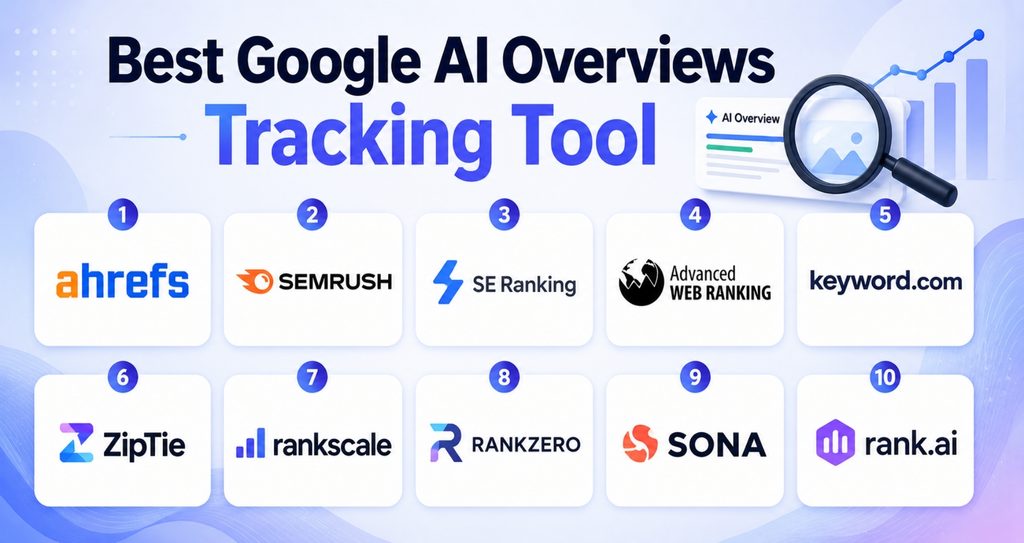
The best Google AI Overviews tracking tools include Ahrefs, Semrush, SE Ranking, Advanced Web Ranking, Keyword.com, ZipTie, Rankscale, RankZero, Sona, and Rank.ai.
Your choice depends on what you need. If you already use a large SEO platform, Ahrefs or Semrush may be the easiest option. If your main goal is monitoring AI visibility and citations, newer AI-focused platforms can give you more detailed tracking.
What Is a Google AI Overviews Tracking Tool?
A Google AI Overviews tracking tool monitors how your website or brand appears inside Google’s AI-generated answers.
Traditional rank tracking tells you something like:
Your page ranks at position 4.
AI Overview tracking asks a different question:
Does Google mention or cite your page in the AI Overview?
That difference matters.
Google AI Overviews can appear above the normal organic listings. Google has also been expanding how prominently these summaries appear in search results.
So, checking only your traditional rankings may not give you the full picture.
Why Should You Track Google AI Overviews?
Imagine you rank number one for an informational keyword.
You are happy with the ranking.
But Google starts showing an AI Overview above the organic results. Your page is not cited, while three competitors are.
Your ranking has not changed, but your visibility may have.
This is why I would track three things:
- Whether an AI Overview appears
- Whether your brand or page is mentioned
- Which URLs does Google cite
Some tools also show competitor citations and changes over time.
Google Search Console does not currently separate AI Overview impressions and clicks from normal organic performance, which makes third-party tracking useful.
10 Best Google AI Overviews Tracking Tools
1. Ahrefs
Ahrefs is one of the easiest choices if you already use it for keyword research and backlink analysis.
Its AI Overviews Tracker can show:
- AI Overview visibility
- Brand mentions
- Pages cited by Google
- Competitor visibility
- Changes over time
- Keyword and prompt-based opportunities
Ahrefs also offers a free AI Overviews checker, so you can get a quick idea of how a brand appears before paying for deeper tracking.
Best for: SEO professionals who already use Ahrefs.
My take: If Ahrefs is already part of your workflow, I would start here rather than adding another tool.
2. Semrush
Semrush has added several ways to monitor AI Overviews.
Its tools can help you identify:
- Keywords that trigger AI Overviews
- AI Overview opportunities
- Brand mentions
- Competitor visibility
- Changes in AI visibility
- Industry-level AI Overview activity
Semrush says its Position Tracking tool can monitor daily AI Overview presence for selected keywords. Its Sensor can also help monitor changes across search results.
Best for: Agencies and SEO teams managing multiple SEO activities in one platform.
My take: Semrush makes sense when you want AI Overview tracking alongside regular keyword and competitor research.
3. SE Ranking
SE Ranking is another option worth checking if you want AI Overview data alongside traditional rank tracking.
The main benefit is keeping your normal SEO monitoring and AI search visibility in the same workflow.
It can be useful for tracking a fixed list of important keywords rather than trying to monitor every query your website could rank for.
Best for: Small SEO teams and agencies that want a straightforward rank-tracking workflow.
Tip: Start with your money keywords, service keywords, and important informational queries. Don’t add hundreds of keywords just because the tool allows it.
4. Advanced Web Ranking
Advanced Web Ranking is known for detailed SERP tracking and can be useful when you need a closer look at search-result features.
For AI Overview tracking, the main advantage is understanding how AI features appear alongside traditional rankings.
Best for: SEO professionals who need detailed SERP monitoring.
This can be especially useful for agencies where clients ask questions like, “Why did our traffic change even though our rankings stayed similar?”
That is exactly the kind of situation where SERP feature tracking helps.
5. Keyword.com
Keyword.com is another platform included in current AI Overview tracking tool comparisons.
Its focus is particularly useful for marketers who want to connect traditional keyword tracking with newer search features.
Best for: Businesses and agencies that want keyword-level monitoring.
When comparing tools like this, don’t just look at how many keywords they claim to track. Check whether they show the actual AI Overview, cited URLs, competitors, location data, and historical changes.
Those details are much more useful than a large number on a pricing page.
6. ZipTie
ZipTie focuses on AI search visibility and tracking.
It is worth considering if your SEO work is moving beyond traditional blue-link rankings and into AI search monitoring.
Best for: Teams specifically interested in AI visibility.
One thing I would check before choosing any AI tracking platform is how it collects its data. A useful tool should give you enough information to understand why your visibility changed, not just display a score.
7. Rankscale
Rankscale is built around AI search visibility tracking.
Its AI Overviews rank tracker monitors:
- Search terms
- Brand mentions
- Citations
- Regions
- Visibility
- Competitors
It also provides scheduled tracking, which is useful because AI Overview results can change over time.
Best for: Marketers who want a dedicated AI visibility dashboard.
A simple use case would be tracking 50 important commercial queries every week and checking whether your brand is being cited.
8. RankZero
RankZero takes a more focused approach to Google AI Overviews.
It tracks whether an AI Overview appears, whether your brand is mentioned or linked, which competitors appear, and which sources Google uses.
Best for: Businesses that want detailed citation and competitor monitoring.
This type of tracking can answer a question traditional rank trackers usually cannot:
“Who is Google trusting instead of us?”
That can lead to useful content ideas.
9. Sona
Sona is another AI visibility platform that includes Google AI Overview tracking.
It focuses on monitoring whether your website gets cited for target queries and comparing visibility with competitors. It also positions AI Overview tracking alongside visibility across other AI platforms.
Best for: Teams looking at Google AI Overviews as part of a wider AI search strategy.
If your business is also watching ChatGPT, Perplexity, or Gemini, having those areas together can be convenient.
10. Rank.ai
Rank.ai is designed around AI visibility across several platforms, including Google AI Overviews.
It lets users track prompts and monitor whether brands are mentioned or cited. The platform also supports daily checks and competitor visibility monitoring.
Best for: Marketers who want to monitor several AI search platforms rather than Google alone.
This is useful if your audience is starting to search for products and services through multiple AI tools.
Google AI Overviews Tracking Tools Compared
| Tool | Best For | AI Overview Tracking | Competitor Tracking |
| Ahrefs | SEO professionals | Yes | Yes |
| Semrush | Agencies | Yes | Yes |
| SE Ranking | Small teams | Yes | Yes |
| Advanced Web Ranking | SERP tracking | Yes | Yes |
| Keyword.com | Keyword monitoring | Yes | Yes |
| ZipTie | AI visibility | Yes | Yes |
| Rankscale | AI visibility dashboards | Yes | Yes |
| RankZero | Citation tracking | Yes | Yes |
| Sona | Multi-platform AI visibility | Yes | Yes |
| Rank.ai | AI search monitoring | Yes | Yes |
Features can change, so check the current product documentation before choosing a paid plan.
Which Google AI Overviews Tool Should You Choose?
There is no single tool that is perfect for everyone.
I’d look at it this way:
Already using Ahrefs?
Try Ahrefs first.
Already using Semrush?
Its AI Overview tracking can fit naturally into your existing SEO workflow.
Want dedicated AI visibility tracking?
Look at tools such as Rankscale, RankZero, Sona, or Rank.ai.
Need detailed SERP monitoring?
Advanced Web Ranking may be worth considering.
Managing SEO for several clients?
Prioritize reporting, competitor comparison, location tracking, and historical data.
The biggest mistake is choosing a tool because it has the longest feature list.
You need the data that helps you make better SEO decisions.
How to Use an AI Overview Tracking Tool
You don’t need to track every keyword.
Start with 20 to 50 important queries.
Step 1: Choose your keywords
Include:
- Main service keywords
- Product keywords
- Commercial searches
- Long-tail questions
- “Best” searches
- Comparison searches
- Informational queries
Step 2: Check AI Overview presence
Find out which keywords regularly produce an AI Overview.
Some queries may show one, while others don’t.
Step 3: Check citations
Look at which websites Google cites.
Are they competitors?
Are they publishers?
Are they Reddit discussions, product pages, research papers, or service pages?
This can reveal patterns in the sources Google uses.
Step 4: Compare your website
Check whether your page is:
- Mentioned
- Cited
- Missing
- Ranking organically but absent from the AI Overview
That last situation is worth investigating.
Step 5: Track changes
Don’t make a change today and check once next month.
AI-generated results can change frequently. Ahrefs, for example, reports high volatility in AI Overview content, which is one reason repeated tracking is more useful than a one-time check.
Common Mistakes When Tracking AI Overviews
Tracking only your rankings
A number-one ranking does not automatically mean you appear in the AI Overview.
Looking only at mentions
A brand mention and a citation are not the same thing.
Check whether Google links to the page you want users to discover.
Tracking too many keywords
A huge keyword list can make reporting messy.
Start small and focus on queries that matter to your business.
Checking only once
AI Overviews can change. One screenshot is only a snapshot.
Ignoring competitors
If another website keeps getting cited for your important queries, study what it offers.
Look at the page structure, information depth, original research, author information, examples, and sources.
Don’t copy it. Learn from the gap.
What Should You Do If Your Website Is Not Cited?
Don’t panic.
Start with the pages that already rank well.
Ask:
- Does the page answer the query directly?
- Is the information easy to understand?
- Does it cover related questions?
- Are claims supported by trustworthy sources?
- Is the author information clear?
- Is the content updated?
- Does the page provide something useful beyond basic information?
For example, if you’re writing about an SEO course, don’t just say what the course includes.
Answer practical questions such as who it is suitable for, what students learn, what tools they practice with, and what beginners commonly struggle with.
If someone is searching for the Best Digital Marketing Course in Nagpur, useful local information can also make the page more helpful. Explain the course structure, practical training, tools, location, learning format, and who should consider it.
The goal should be to answer the user’s actual question.
Frequently Asked Questions
What is the best Google AI Overviews tracking tool?
Ahrefs and Semrush are strong choices for SEO professionals who already use larger SEO platforms. Dedicated tools such as Rankscale, RankZero, Sona, and Rank.ai can be useful when AI visibility and citations are the main focus. The right choice depends on your keyword volume, reporting needs, competitors, and budget.
How does Google AI Overview tracking work?
An AI Overview tracking tool checks selected search queries and records whether Google displays an AI Overview. Depending on the platform, it can also identify brand mentions, cited URLs, competitors, and changes over time. This gives you information that normal rank tracking does not provide.
Why should I track AI Overviews for SEO?
AI Overviews can appear above traditional organic listings. If your competitors are cited while your website is not, your traditional ranking may not tell the whole story. Tracking helps you understand where your content appears in Google’s AI-generated answers and where you may have gaps.
Can Google Search Console track AI Overview visibility?
Google Search Console does not currently provide a separate AI Overview report. AI Overview clicks and impressions are included with regular search performance data, making it difficult to isolate their impact. Third-party tools can provide more specific AI Overview visibility and citation data.
How often should I check Google AI Overviews?
For important commercial keywords, weekly tracking is a practical starting point. If your industry changes quickly or you are actively testing content changes, more frequent tracking can be useful. The key is consistency rather than checking randomly.
Is an AI Overview mention the same as a citation?
No. A mention means the AI answer refers to your brand or website. A citation usually means Google provides a link to a source used for the answer. When measuring SEO visibility, it is useful to track both.
Final Thoughts
AI Overviews have added another layer to SEO.
You still need strong organic rankings. You still need useful content. You still need good technical SEO.
But now there is another question to ask:
When Google answers, is your website part of that answer?
That is where AI Overview tracking becomes useful.
Start with your most important keywords. Track the AI Overview presence, citations, competitors, and changes over time. Then use what you learn to improve the pages that matter most.
You don’t need ten tools.
Pick one that fits your current SEO workflow and actually use the data.
